
A commercial solar project can place thousands of pounds of distributed load across a rooftop long before the first kilowatt-hour is produced.
That's why experienced project teams spend considerable time evaluating structural design before finalizing equipment selection.
Panels, inverters, and production estimates often receive the most attention during project planning. Beneath those discussions lies another layer of decision-making that directly impacts system longevity, maintenance access, roof compatibility, and operational reliability.
The solar structural rail system sits at the center of those decisions. It serves as the framework that connects solar modules to the building while helping manage structural loads, environmental forces, and long-term movement across the array.
This guide examines the design considerations that engineers, EPC firms, roofing consultants, and project managers evaluate when planning commercial rooftop solar installations.
Why Structural Design Starts Before Equipment Selection
Many commercial solar discussions begin with module specifications.
Higher wattage. Improved efficiency. Energy production targets. Those metrics are important, but structural planning often begins much earlier.
Before modules are selected, project teams are evaluating:
Roof age
Structural capacity
Attachment strategies
Environmental loading
Maintenance access
Future reroofing considerations
A well-designed solar structural rail assembly must work within the realities of the building itself.
The strongest rail system on paper may not be the best fit for the roof beneath it.
That reality becomes especially important for aging commercial buildings, where the lifespans of roofs and solar systems may not align perfectly.
Understanding Load Paths Across a Commercial Array
One of the most important design questions is deceptively simple:
Where do the loads go?
Wind uplift, snow accumulation, dead loads, and thermal movement all create forces that travel through the mounting system.
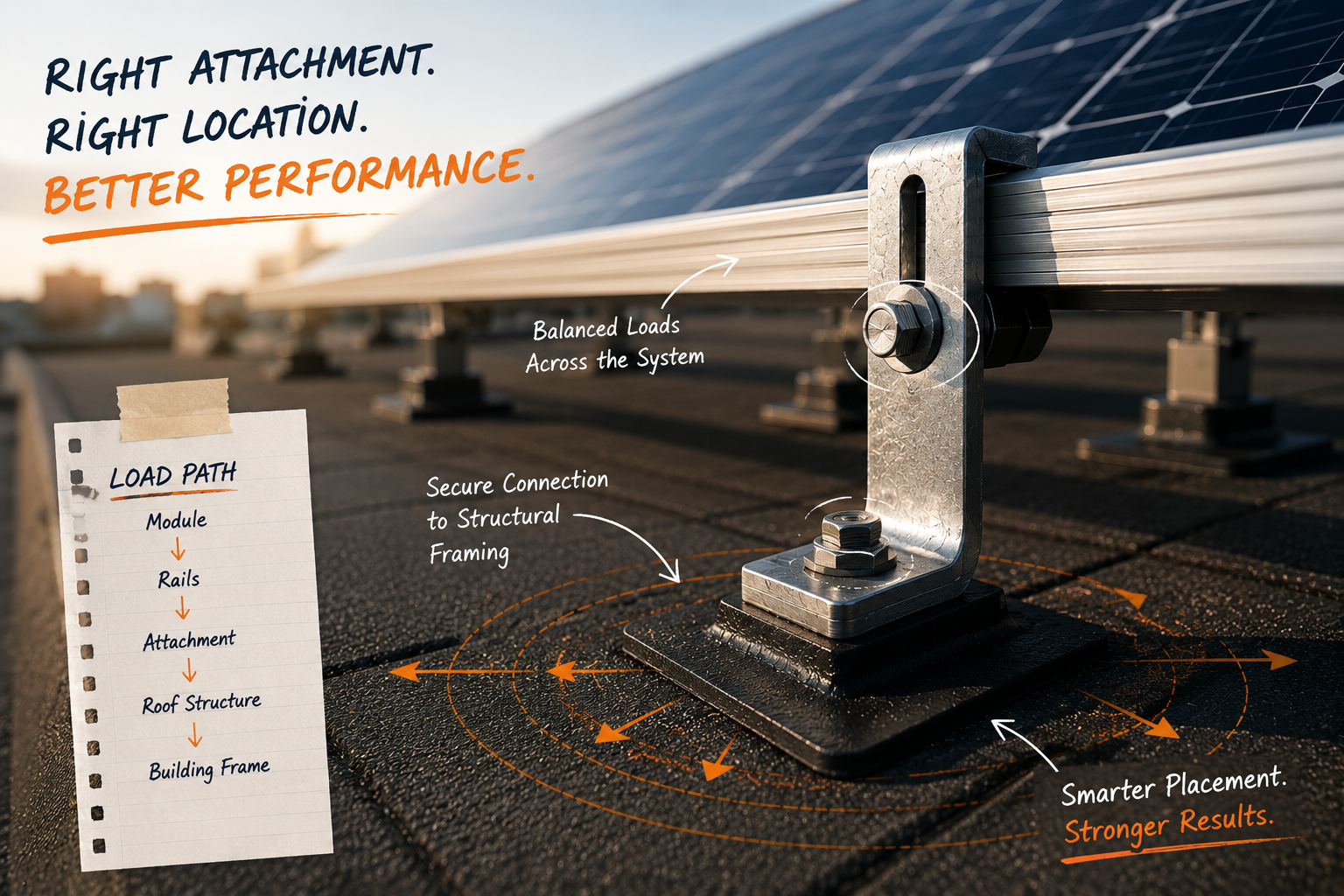
A typical load path follows this sequence:
Solar modules receive environmental forces.
Clamps transfer those forces into the rail assembly.
The rail system distributes loads across attachment points.
Attachments transfer loads into the roof structure.
The building structure ultimately supports the array.
Each component influences the next.
A design decision made at the attachment level can affect the performance of the entire system.
This is one reason structural planning receives significant attention on larger commercial projects.
Design Variables Engineers Evaluate
Commercial rooftops rarely present identical conditions.
Engineers often evaluate multiple variables before finalizing a rail layout.
Roof Geometry
Large facilities may contain multiple roof elevations, equipment curbs, drainage systems, skylights, and access pathways.
Each feature can influence rail placement.
Environmental Loading
Projects in Minneapolis face different loading requirements than projects in Phoenix.
Snow loads, wind exposure, and regional weather conditions influence structural design decisions.
Thermal Movement
Long rail runs experience expansion and contraction over time.
Ignoring thermal movement can introduce unnecessary stress throughout the mounting assembly.
Serviceability
A solar array should not make future roof maintenance unnecessarily difficult.
Maintenance access often becomes a major consideration during commercial design reviews.
Commercial Roofs Present Different Challenges Than Many People Expect
A commercial roof may appear relatively simple from ground level.
Once design work begins, complexity often emerges.
Project teams frequently encounter:
Roof sections added during previous expansions
Existing rooftop equipment
Aging waterproofing systems
Drainage constraints
Structural modifications from prior renovations
These conditions don't necessarily prevent solar installation.They simply require thoughtful planning.
What looks like a straightforward layout during an early site visit can evolve significantly during engineering review.
Why Layout Flexibility Matters
One of the more overlooked aspects of commercial solar design is adaptability.
Projects change.
Roof conditions change.
Building requirements change.
That's one reason many engineering teams value flexible rail-based solar layouts when evaluating long-term installation strategies.
A layout that accommodates future maintenance requirements, equipment upgrades, and rooftop modifications often provides greater operational value than a design optimized solely for installation speed.
The discussion isn't always about maximizing module count. Sometimes it's about preserving long-term functionality.
Looking Beyond the Installation Phase
Commercial solar systems are expected to remain in service for decades.
Project teams that focus exclusively on installation-day efficiencies may overlook future operational challenges.
Questions about roof access, maintenance workflows, reroofing logistics, and long-term serviceability often become increasingly important as systems age.
The best-performing projects are usually designed with both construction and operations in mind.
What Roofing Professionals Continue to Emphasize
Roofing professionals have long emphasized that rooftop photovoltaic systems must be designed with structural compatibility, maintenance access, and long-term roof performance in mind. As commercial solar adoption continues to grow, coordination between the roof assembly and mounting structure remains a critical part of project planning.
As commercial solar installations continue to expand across a wide range of building types, proper coordination among structural design, roofing systems, and mounting assemblies remains critical to long-term project performance.
This mirrors what engineers and contractors often observe in practice. Long-term success is rarely tied to a single component. It is usually the result of multiple design decisions working together from the earliest stages of project planning.
Final Thoughts
Commercial solar projects are often evaluated through the lens of energy production.
Experienced project teams know the conversation starts much earlier.
A properly designed solar structural rail system helps support load distribution, maintenance access, roof compatibility, and long-term operational reliability. These considerations may not be visible once installation is complete, but they often determine how the project performs years down the road.
Before focusing exclusively on module specifications and production estimates, it's worth taking a closer look at the structure supporting the array. That's where many long-term performance decisions are made.
Frequently Asked Questions
1. What is a solar structural rail?
A solar structural rail is a load-bearing component that supports solar modules and transfers structural forces from the array into the building structure.
2. Why is structural rail design important in commercial solar projects?
Structural rail design influences load distribution, attachment planning, maintenance access, roof compatibility, and long-term system performance.
3. How does environmental loading affect rail design?
Wind uplift, snow loads, and thermal movement can all influence rail sizing, attachment spacing, and overall system design.
4. Can rail design affect future reroofing projects?
Yes. Rail layout and attachment planning can significantly influence how easily future roof maintenance and reroofing activities are performed.
5. What role does thermal expansion play in commercial solar design?
Thermal expansion affects long rail runs over time. Proper planning helps reduce stress throughout the mounting assembly.
6. Why do engineers evaluate roof conditions before finalizing rail layouts?
Roof geometry, structural capacity, drainage systems, and existing rooftop equipment all influence mounting design decisions.

Write a comment ...